
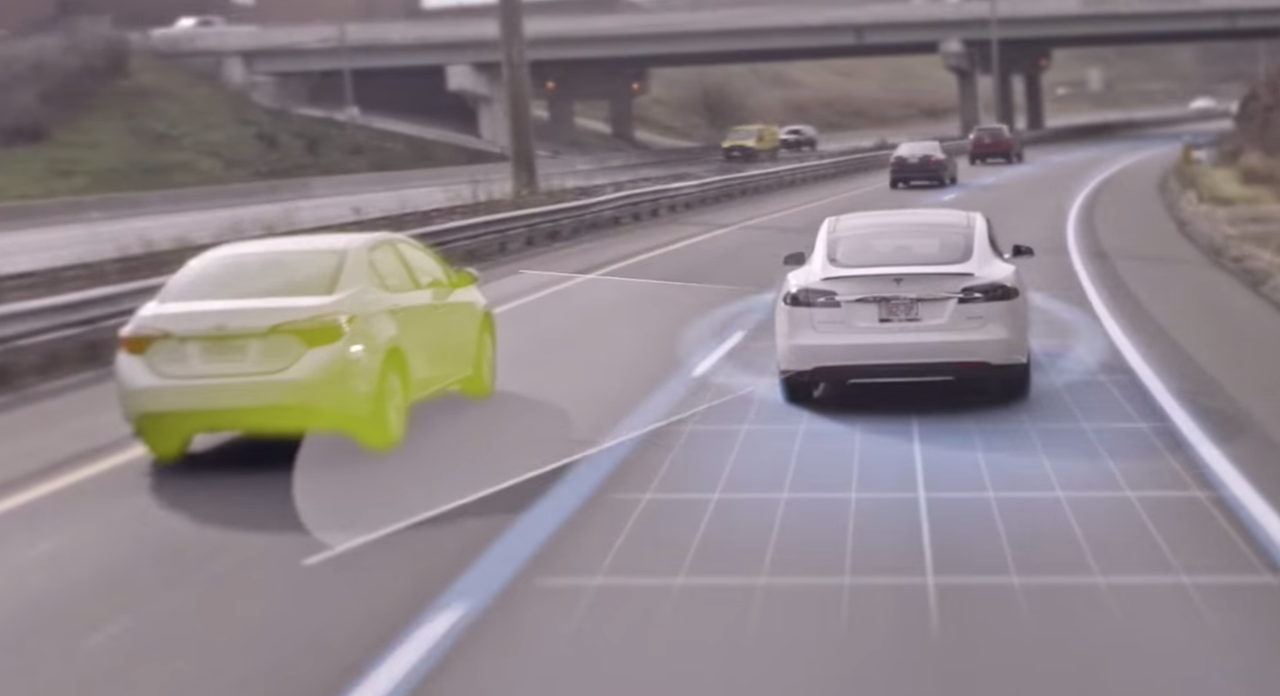
 An exciting feature the Tesla Model S includes in their vehicle is the Autopilot. The way the autopilot works is that it uses the eight cameras and 12 sensors scattered around the car in a hidden fashion to identify its surroundings and maneuver as needed. The ultrasonic sensors complement the camera's vision, feeding information to the car that is requires to calibrate when and where to move.
The ultrasonic sensors work by using ultrasonic waves. The waves help identify the car's surroundings. Different objects reflect ultrasonic waves differently. Take reference to the image on the left. A driver wants to switch lanes and decides to activate autopilot mode. Since the material of the passing car is metal, ultrasonic waves will be absorbed by the vehicle. Thus, the ultrasonic sensor can identify that there is an oncoming vehicle, and the car cannot switch lanes yet.
The cameras have a maximum visibility range of 250 metres and the ultrasonic sensors provide a maximum range of 8 metres. It is told by the CEO of Tesla,Elon Musk, that the ultrasonic sensors provide "a redundant wavelength that is able to see through heavy rain, fog, dust and even the car ahead.".
All Tesla Cars, including the Model S, uses something called Regenerative Braking or ‘Regen’. The function of this system is to convert the car’s kinetic energy into chemical energy which can be stored in the battery of the car and be used later as fuel for the car, hence, the term regenerative.
Instead of using internal combustion engines like a traditional vehicle, the Model S has an advanced algorithm in the motor to which gives the motor full capability to control torque force. Torque would then be converted into voltage and current waveforms, creating energy. This is key to an efficient method of energy regeneration. It can determine when to use a positive or negative torque(negative meaning to go in the opposite direction) and the speed at which the motors are spinning. These factors come into play when extracting the most energy gainable to max efficiency. It is when the motors decelerate, the energy starts to go back to the battery, where the cycle will begin again. That being said, even when the car slows down for the slightest chance, the smallest amount of energy will be stored in the battery. This can happen when stopping at a red light, busy in rush hour traffic, or even a simple three-second stop sign halt.
There are several factors that determine the amount of energy converted. Two obvious ones are mass and speed of the car, in reference to the kinetic equation. If the vehicle has two times its mass and double its speed, the amount of kinetic energy exerted is multiplied by four. Conservation law speaks that energy cannot be destroyed, thus, the kinetic energy exerted must go somewhere. There are several places for the energy to go. In terms of aerodynamics, kinetic energy will be released into the air surrounding the car, torque manifests in the resistance in speed of spin, and mechanical friction which is found when the ground is pushing the car in the opposite direction as newton third law states for every action there is a simultaneous reaction in the opposite direction. However, the vast majority of energy released from the kinetic energy is thermal energy, the heat from the rapid movement of the particle from the car. The thermal energy can be found in the brake pads of the car when it yields/stops via brakes. Because the vast majority of the energy is found in the brake pads, Tesla thought intelligently and decided to create Regen where that energy can be converted into chemical energy, stored in the battery, and then can be reused again, creating this efficient system.
Not all of the energy can be converted as some are released into the air and other places as mentioned earlier. That being said, not 100% of kinetic energy is converted into chemical energy, meaning, not 100% of the energy will be reused in the cycle. Energy is released during the conversion from DC current (battery) to AC current when working the motor itself, torque(spin on the wheel) and vice versa when energy is returned to the battery. However, a lot of the energy lost due to friction working against the car and aerodynamics. According to Tesla, the battery to wheel conversion efficiency is approximately 80% and the amount of energy regenerated is also 80% in which the two are multiplied the net efficiency results to be 64%.